01 Overview
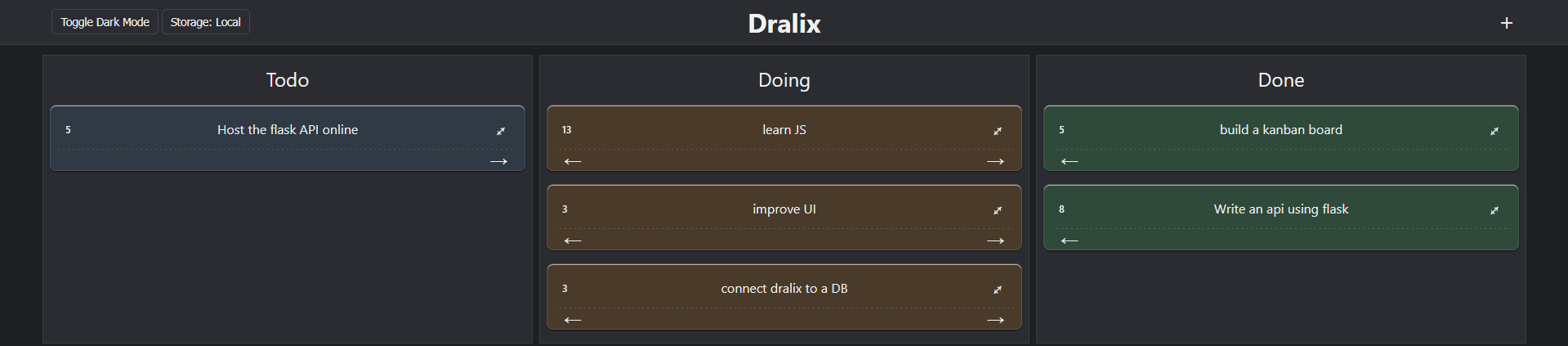
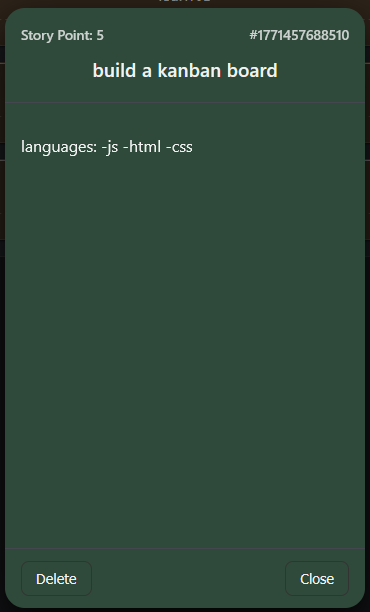
Dralix is a kanban board for agile task management. It lets you create,
edit, and delete tasks across columns, drag cards between columns,
estimate story points, and switch between local storage and a database
backend.
The project started as a way to force myself to learn JavaScript
properly. I'd been learning Python and felt comfortable with the
backend, but I hadn't built anything serious with JS. Rather than
following a tutorial, I picked a real project with real features and
built it until it worked.
03 Story point estimator
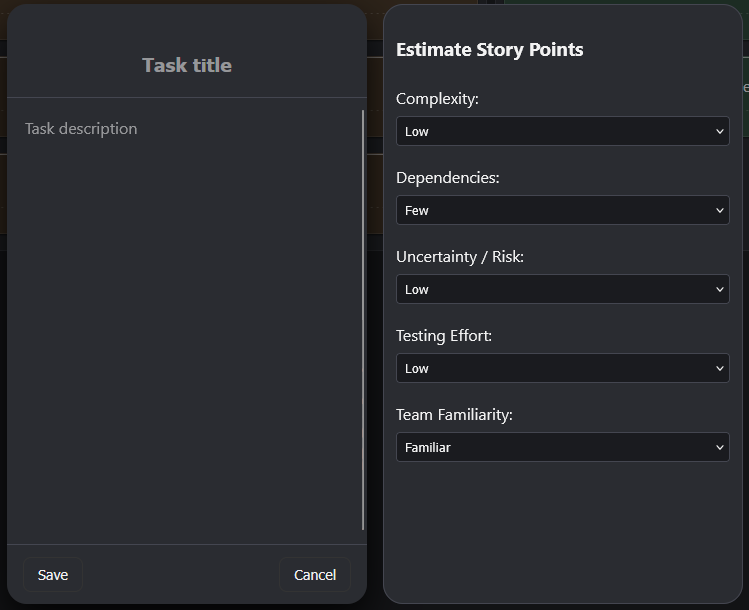
One feature I'm particularly proud of is the story point estimator. When
creating a task, you can estimate its complexity across four dimensions:
complexity, uncertainty, development time, and testing effort. The
estimator applies a weighted calculation across these inputs and
suggests a value from the Fibonacci sequence.
The reason for Fibonacci is the same as in real agile teams — the
increasing gaps between numbers reflect that estimating large tasks is
inherently less precise. The goal is to remove subjective guesswork and
keep estimates consistent across the board.
04 The backend API
api/routes.py
@app.route("/api/tasks", methods=["POST"])
def create_task():
    from models import Task
    data = request.get_json()
    task = Task(
        title=data.get("title", "No title"),
        status=data.get("status", "todo"),
        description=data.get("description", ""),
        storypoint=data.get("storyPoint", 1)
    )
    db.session.add(task)
    db.session.commit()
    return jsonify({"message": "Task created"}), 201
The REST API is built with Python and Flask. It exposes endpoints for
full CRUD operations on tasks, with SQLAlchemy handling the ORM layer
and MySQL storing the data. The API is intentionally separate from the
frontend — the kanban board talks to it over HTTP and can fall back to
localStorage if the API isn't running.
models.py
class Task(db.Model):
    id          = db.Column(db.Integer, primary_key=True)
    title       = db.Column(db.String(150), nullable=False)
    description = db.Column(db.Text)
    status      = db.Column(db.String(50), default="todo")
    storypoint  = db.Column(db.Integer, default=1)
The Task model defines how data is structured and stored. It enforces
consistent formatting between the API and the MySQL database, acting as
the core data layer for the whole application.
06 What I'd do differently / what's next
If I were to build Dralix again, I'd probably add user accounts and
real-time collaboration features. It would be interesting to implement
WebSockets for live updates across clients and see how that changes the
architecture. I'd also consider adding more advanced task features like
subtasks, attachments, and integrations with calendar apps. I would also
use a frontend framework like React or Vue to manage the UI more
efficiently. The vanilla JS implementation was a great learning
experience, but it would be more maintainable and scalable with a
framework.